
How to avoid double-paying your mutual fund taxes

http://www.rowanmagazine.com/departments/alumniadvisor/archive/taxes/

How to avoid double-paying your mutual fund taxes
by Ric Edelman ’80

or all the advantages offered by mutual funds, taxation is certainly not one of them. In fact, it’s the biggest headache associated with owning them. Mutual funds are not investments, but rather pools of money that buy investments. Say you own a stock fund and the fund manager buys a stock. Further say the stock pays a dividend and grows in value, and the fund manager then sells the stock. You’ll receive a dividend distribution, which is taxable as all dividends are taxed, and you’ll also receive a capital gains distribution, taxable at capital gains rates.

Thus, even if you might have owned the fund for just a month or two, and even though you have not yet sold the shares of your fund that you originally bought, it’s quite possible that you could receive a long-term capital gain distribution. This would occur because the fund sold an asset that it had held for the requisite period of time (more than 12 months), even though you have only held the fund for a short period and haven’t sold any shares yet.

Are you overpaying taxes on your mutual funds?
All this leads to a surprisingly common mistake among mutual fund investors: They pay taxes twice on their mutual fund profits. I’ll bet this is true even for those who automatically reinvest their distributions.

The IRS contends that when your fund declares a dividend or capital gain, it is your choice to reinvest this distribution or not. Since most investors choose to reinvest, millions of mutual-fund investors overpay the taxes due on their mutual funds.

Here’s how it happens: Let’s say Casey invests $10,000 into a bond fund that pays an 8% annual dividend, or $800. Casey automatically reinvests this $800 and the fund gives him more shares. At tax time, Casey must pay taxes on the $800 he earned that year.

If Casey were to do this for five years, he would earn a total of $4,000 in dividends (I’m ignoring compounding to keep this example simple), and he’d pay taxes each year along the way. At the end of the five years, his fund would be worth $14,000 (his original investment of $10,000 plus the $4,000 in dividend reinvestments). Thus, if Casey were to sell his fund, he would receive a check for $14,000. Therefore, he would owe nothing in taxes because he had already paid them.

But many fund investors blow it. They forget they’ve paid taxes each year on the dividends; when they sell their fund and get their check for $14,000, they also get from the fund an IRS Form 1099 stating that amount (it’s called gross proceeds). They dutifully give the 1099 to their tax preparer who asks, in an effort to determine the profit they earned (and thus the tax owed), “How much did you invest in this, anyway?”

And they say, “Ten grand,” and the tax preparer records that they made a profit of $4,000, includes it on their Schedule D, and they end up paying taxes on that profit all over again! This sounds preposterous, but I can assure you it is perhaps the most common tax mistake made by mutual fund investors.

Do you see the trap? Most investors think the “amount invested” is the amount of money they sent to the fund. But the IRS says all reinvested dividend and capital gain distributions count as “investments,” too. Therefore, when Casey’s accountant asked how much Casey invested, Casey’s answer should have been $14,000—not $10,000!

You can avoid this problem simply by following these steps: keep all your mutual-fund statements, and when your tax preparer asks you a question, don’t answer. Instead, give your tax preparer the statements you collected.

Casey’s reply should have been, “How much did I invest? I don’t know. That’s what I hired you for! Here—take my statements and figure it out yourself!” If you prepare your own taxes, be aware of this trap.

What to do if you sell only part of an investment
You certainly can’t sell “part” of a house—but you can sell part of other investments. Say that over a period of 10 years, you accumulate 1,000 shares of a mutual fund that are now worth $25 per share, for a total of $25,000. Also say you need five grand for a down payment on a car, so you sell 200 shares. Which shares did you sell—the ones you bought 10 years ago, the ones you acquired most recently, or those in between?

Your answer could make a big difference come tax time. Your first reaction might be to sell the oldest shares, so that the sale is treated as a long-term gain, and subject to the lowest capital gains rate. But the oldest shares are probably the cheapest that you purchased—meaning their profit is the highest. So maybe it makes sense to sell the newest shares first—even though their sale is considered short term. Still, depending on what’s happened in the market lately, some of the middle shares might be the best candidates for sale.

Clearly, the shares you sell will determine your tax liability. The problem is that most investors don’t know that they have a choice. And, actually, you have four choices (see below). But make your selection carefully, for once you pick a method, you cannot change it for that particular investment.

Four ways to sell investments
The FIFO method
First In-First Out assumes you first sell the shares you bought first. (The first person who gets on the bus is the first person to get off the bus.) This is the default method; the IRS (as well as your broker or mutual fund company) assumes you use this method unless you notify them otherwise.

The specific identification method
You name which shares you are selling (you do this by referring to the date you acquired the shares to be sold). For this method to be successful, you must specify to the mutual fund company or to the advisor of record serving your account the particular shares to be sold, and you must do this at the time of sale. Furthermore, you must receive confirmation of your specification from your advisor in writing within a reasonable time, and the confirmation by the mutual-fund company must confirm that you instructed your advisor to sell particular shares.

The average cost single method (only available for mutual funds)
Figure the tax on the average cost and the average profit from all your trade lots.

The average cost double method (only available for mutual funds)
Separate the trade lots into two groups: those held one year or less and those held more than one year, and then figure the tax on the average of each group.
Posted in Money | Leave a comment

Google App Engine Setup Revised

Installation:

Setting up your project:

  1. Create a directory
  2. Create two files main.py and app.yaml
    app.yaml:

    application: mytestapp
    version: 1
    runtime: python27
    threadsafe: true
    api_version: 1
    default_expiration: "5d 12h"

    handlers:
    - url: /.*
    script: main.app

    main.py:

    import webapp2

    class Index(webapp2.RequestHandler):
    def get(self):
    self.response.out.write('hello world!')

    mappings = [('/', 'main.Index')]
    app = webapp2.WSGIApplication(mappings)

  3. Launch VS. File->New->Project->Python Templates->From Existing Python Code
  4. Add above two files to the project
  5. Alt->ENTER->General. Set Startup File to C:\Program Files (x86)\Google\google_appengine\dev_appserver.py
  6. Alt->ENTER->Debug. Set Script Arguments to directory in step 1
  7. F5
  8. You will get a ZipImportError. Fix it using this link: http://pytools.codeplex.com/discussions/265255
  9. Verify this output in python shell:
    INFO 2013-03-10 15:07:15,349 appcfg.py:618] Checking for updates to the SDK.

    INFO 2013-03-10 15:07:16,717 appcfg.py:636] The SDK is up to date.
    WARNING 2013-03-10 15:07:16,720 dev_appserver.py:3578] The datastore file stub
    is deprecated, and
    will stop being the default in a future release.
    Append the –use_sqlite flag to use the new SQLite stub.

    You can port your existing data using the –port_sqlite_data flag or
    purge your previous test data with –clear_datastore.

    WARNING 2013-03-10 15:07:16,779 simple_search_stub.py:975] Could not read searc
    h indexes from c:\users\me\appdata\local\temp\dev_appserver.searchindexes
    INFO 2013-03-10 15:07:17,049 dev_appserver_multiprocess.py:656] Running appl
    ication dev~mytestapp on port 8080: http://localhost:8080
    INFO 2013-03-10 15:07:17,052 dev_appserver_multiprocess.py:658] Admin consol
    e is available at: http://localhost:8080/_ah/admin

  10. Open web browser, navigate to http://localhost:8080/
  11. Verify web page that says hello world!
  12. Now to break above code (just for testing), simply change
    mappings = [('/', 'main.Index')]
    to
    mappings = [('/', 'Index')]

    Now if you refresh the webpage, you will see:
    500 Internal Server Error

    The server has either erred or is incapable of performing the requested operation.

    Python shell will show:
    ERROR 2013-03-10 15:10:17,605 webapp2.py:1552] import_string() failed for ‘In
    dex’. Possible reasons are:

    – missing __init__.py in a package;
    – package or module path not included in sys.path;
    – duplicated package or module name taking precedence in sys.path;
    – missing module, class, function or variable;

    Original exception:

    ImportError: No module named Index

    Debugged import:

    – ‘Index’ not found.
    Traceback (most recent call last):
    File “C:\Program Files (x86)\Google\google_appengine\lib\webapp2-2.5.2\webapp2
    .py”, line 1535, in __call__
    rv = self.handle_exception(request, response, e)
    File “C:\Program Files (x86)\Google\google_appengine\lib\webapp2-2.5.2\webapp2
    .py”, line 1529, in __call__
    rv = self.router.dispatch(request, response)
    File “C:\Program Files (x86)\Google\google_appengine\lib\webapp2-2.5.2\webapp2
    .py”, line 1272, in default_dispatcher
    self.handlers[handler] = handler = import_string(handler)
    File “C:\Program Files (x86)\Google\google_appengine\lib\webapp2-2.5.2\webapp2
    .py”, line 1852, in import_string
    return __import__(import_name)
    ImportStringError: import_string() failed for ‘Index’. Possible reasons are:

    – missing __init__.py in a package;
    – package or module path not included in sys.path;
    – duplicated package or module name taking precedence in sys.path;
    – missing module, class, function or variable;

    Original exception:

    ImportError: No module named Index

    Debugged import:

    – ‘Index’ not found.
    INFO 2013-03-10 15:10:17,674 dev_appserver.py:3104] “GET / HTTP/1.1” 500 –

Posted in Software | Leave a comment

Notes on VGPMX

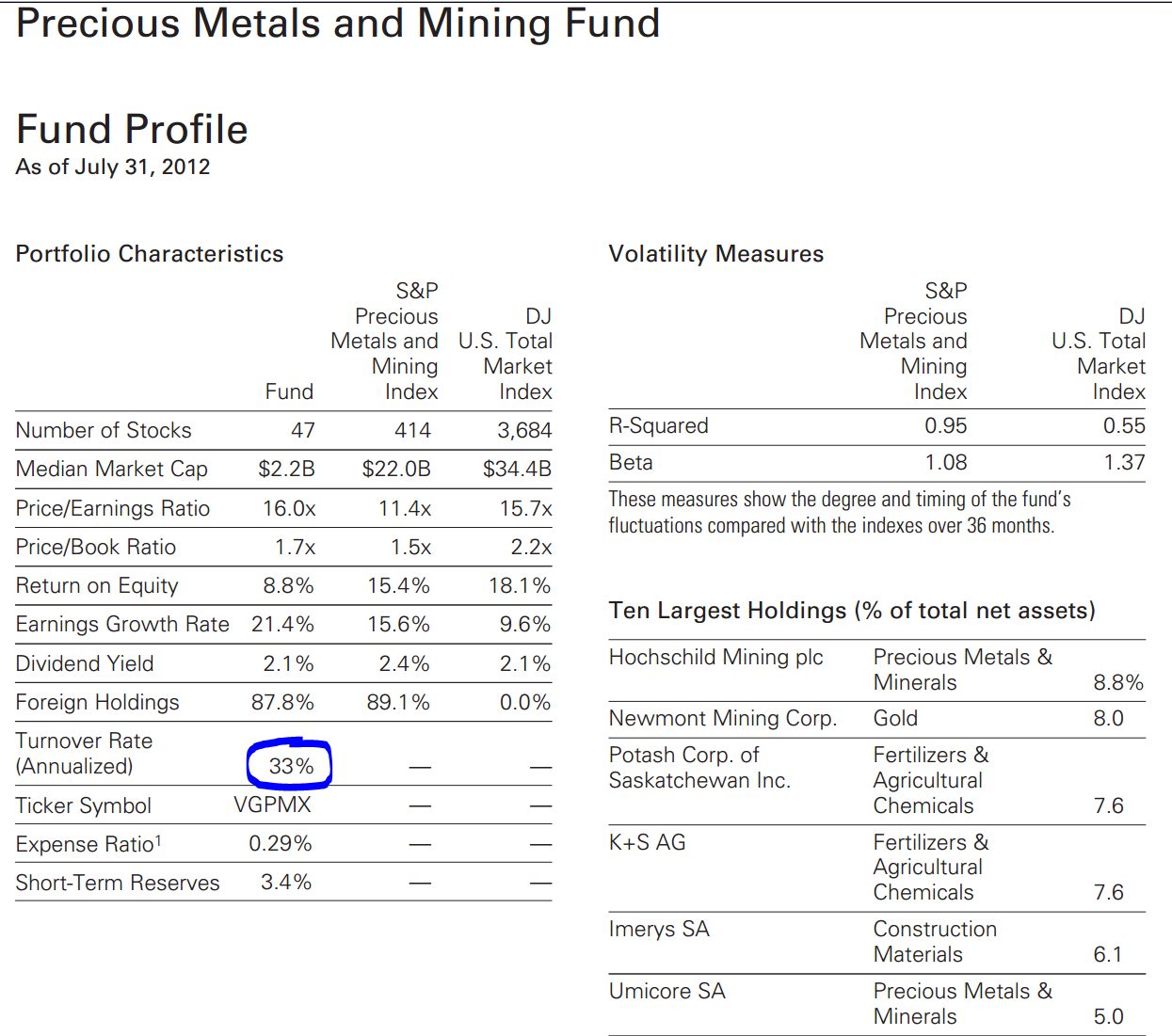
Although morningstar gives it a Gold rating, I was disappointed to discover (see p. 14 of 2012 annual report) that the # of stocks comprising the fund is only 45. Comapre it to 424 stocks that comprise S&P Precious Metals and Mining Index. Also only about 60% of the fund is invested in gold stocks. From p.5:
At the end of the 12 months, gold-oriented stocks accounted for about 56% of the fund’s assets and had contributed about 2.3 percentage points to the overall return.
I also looked at websites of the top holdings.

  1. Hochschild Mining plc – ok this is a gold mining company
  2. Potash Corp. of Saskatchewan Inc. – this is not a gold mining company. Guess what is this company’s product? fertilizers
  3. K+S AG – another fertilizers company
  4. Umicore SA – ok this is a materials company

Have you heard the name of one single company in above list?
vgpmx
This is a different class of fund altogether. This fund is for people who want to play a high-stakes game; those who have strong conviction in performance of a handful of mid-cap companies selected by fund’s management. The companies comprising the fund also change quickly from year to year as reflected by the 33% turnover. On the face of it, this fund stands against the principles of diversification, investing in an index fund, etc. but if you wanted to gamble with a small amount of money and take a chance, then this might be it.
Conclusion: It is very important to look at big picture, and trust what your own common sense tells you.


Looking Back: After more than 10 years of investing in this fund, I came across this article: How I Found a Top-Performing Vanguard Fund by Accident. For the longest time, this fund was amongst the worst performers in my portfolio. It has only appreciated recently due to the surge in gold. Looking back I would say its better to invest in a gold ETF like IAU vs. this fund.

Posted in Money | Leave a comment

Debugging tips

  • Breaking into external code: http://www.aaronlerch.com/blog/2007/08/31/tip-set-breakpoints-without-source-code-in-visual-studio-2005/ except that I tried, and it didn’t work.
  • If you don’t see the Unhandled column under Debug->Exceptions, its because Enable Just My Code is unchecked
  • To debug .net code, see this link: http://weblogs.asp.net/rajbk/archive/2010/04/21/setting-up-visual-studio-2010-to-step-into-microsoft-net-source-code.aspx
    • Check Debug->Options and Settings->General->Enable .NET Framework Source Stepping
    • Check Debug->Options and Settings->General->Enable Source Server Support
    • add http://referencesource.microsoft.com/symbols to Debug->Options and Settings->Symbols

    Once again, I can’t get any of it to work. Access is denied while trying to execute tf.exe view /version:550320 /noprompt “$/DevDiv/D11Rel/FX45RTMRel/ndp/clr/src/BCL/System/MulticastDelegate.cs” /server:http://vstfdevdiv.redmond.corp.microsoft.com:8080/devdiv2 /console > MulticastDelegate.cs.

  • To download .NET source code:

    It also pays to read the setup instructions in the included readme.txt file:

    1. Install Reference Source:
      1. Download Microsoft Reference Source Code Center from http://www.referencesource.microsoft.com.
      2. Install Reference Source to any arbitrary location say ‘C:ReferenceSource’.
    2. Setup Symbols Path:

      1. Launch Visual Studio 2008/2010.
      2. From the Tools menu, choose Options.
      3. In the Options dialog box, open the Debugging node and select General
        – Uncheck “Enable Just My Code (Managed only)”
        – Check “Enable source server support”
        – Uncheck “Require source files to exactly match the original version”
      4. Select Symbols under Debugging.
        In the Symbol File Locations box, add the downloaded symbols location: C:ReferenceSourceSymbols
        Note: To add the Symbols path Click folder icon.
        Enter in text box under ‘Cache symbols from symbol servers to this directory: C:ReferenceSourceSymbolsCache
    3. Debugging your Application
      a) Open your application code solution and build the solution.
      b) Set a break point in the code.
      c) Start debugging (press F5).

    Unfortunately, I have tried all of this and can’t get VS Debugger to break on .net source code. I kept investigating this, and finally I was able to break in when I compiled my application as a 32 bit executable. Although Question #5 on the FAQ site says you should be able to debug 64 bit code, if you run into this problem, try compiling as 32 bit (project->Properties->Debug->set Target = x86)

  • To use SOS commands from VS Immediate window, check Project->Properties->Debug->Enable Native Code debugging. Once again, doesn’t work for me.
    When I type .load sos in Immediate window, I get this error message: Error during command: extension C:WindowsMicrosoft.NETFramework64v4.0.30319sos.dll could not load (error 193). To fix this, change compiler output to 32 bit instead of 64 bit.
    See http://stackoverflow.com/questions/3547228/load-sos-extension-for-debugging
Posted in Software | Leave a comment

Tips on disputing errors on your credit report

http://www.google.com/hostednews/ap/article/ALeqM5i8tPvfZyYtcWYptkEZnnYiycjoTg?docId=4e0257ef527747e99ce3f23271ba55cd
Tips on disputing errors on your credit report
By By ALEX VEIGA, AP Business Writer – 44 minutes ago
Disputing credit report errors can be complicated and frustratingly slow. But it is also a necessary task for Americans who want to avoid paying more on loans and credit cards for a mistake they did not make.
A Federal Trade Commission study released Monday found that one in four consumers surveyed discovered an error in at least one of their credit reports from the three major credit bureaus.
Only 5 percent of the consumers found errors severe enough to increase their rates on mortgage, auto loans and other financial products.
The FTC’s Bureau of Consumer Protection recommends that consumers take steps to ensure the information on their credit reports is accurate. Most negative information can remain a part of your credit history for seven years.
Here are some tips on how to dispute credit report mistakes and lessen the chance of unwarranted blemishes that stain your credit profile:
— GET YOUR CREDIT REPORTS
The first step is to get a copy of your credit report from each of the major credit reporting firms — Experian, TransUnion and Equifax. Consumers are entitled to a free report every 12 months from each of the credit bureaus. You can get copies at http://www.annualcreditreport.com .
It’s important to review your credit history periodically. For one thing, lenders can make errors when they report client accounts to credit bureaus. And if an identity thief opens an account in your name without your knowledge, that can hurt your credit until you discover what’s happened.
— FILE A DISPUTE
If you believe there’s an error in a report, you can submit disputes online at http://www.equifax.com, http://www.experian.com, http://www.transunion.com . You can also submit the dispute by mail or phone, the address or number should be on your credit report.
The FTC’s study found that four out of five consumers who found erroneous information in their credit report and filed a dispute with the credit bureaus had a correction made to at least one of their credit reports.
— BE PATIENT
Once a dispute is received, credit bureaus are required to respond within 30 days. The credit bureau will contact the lender that provided the information that is under dispute. At that point, the lender looks into the matter. If a fix is made, the lender must alert all three credit bureaus of the error.
When the investigation is complete, the credit bureau must provide written results and a free copy of your report if the dispute results in a change. This report does not count as your free annual report.
— CONTACT LENDERS
Another option: Reach out to the lender on the account where the error showed up and ask that they update the credit bureaus with correct information.
— CONTACT THE CFPB
Not getting anywhere with the credit bureaus? Try the Consumer Financial Protection Bureau, a federal agency with the authority to write and enforce rules for the credit reporting industry and to monitor the compliance of the three agencies.
The CFPB also accepts complaints from consumers who discover incorrect information on their reports or are have trouble getting mistakes corrected. And consumers can contact the CFPB if they have issues with the improper use of a credit report, problems with credit monitoring and the improper use of a credit report, among other concerns.
The credit reporting agencies have 15 days to respond to the complaints with a plan for fixing the problem; consumers can dispute that response.
The CFPB also takes complaints on credit cards, mortgages, bank accounts and services, consumer loans and private student loans. To file a credit reporting complaint, consumers can do so at http://www.consumerfinance.gov/Complaint . Or by phone, by calling 1-855-411-CFPB (2372).
— AVOID CREDIT REPAIR FIRMS
The Federal Trade Commission has warned consumers against firms that offer services claiming to improve a person’s credit report for a fee. Such firms can’t do anything that you couldn’t do yourself.
Since credit bureaus are required to check disputed information on a consumer’s credit report within a few weeks, or remove it, a typical tactic of credit repair firms is to spam credit bureaus with such requests in hopes the negative items end up being dropped.
But credit experts say that often those items will show up again the next time the credit card company or other creditor issues an update to the credit bureaus.

Posted in Money | Leave a comment

Buying a house in WA: standard NWMLS agreement does not protect buyer when lender fails to perform

To protect yourself, add these clauses:
It is agreed between buyer and seller that:

  • If lender is unable to perform by the closing date, this agreement will terminate and earnest money will be refunded to buyer
  • Buyer will be given a 24 hour review period before signing any loan docs. If buyer is not given at least a 24 hour review period, buyer reserves the right to terminate this agreement, and get a refund of earnest money
  • If the conditions on loan docs differ by what is spelled out in the Good Faith Estimate (GFE), buyer reserves the right to terminate this agreement, and get a refund of earnest money
  • In case of a lawsuit, the prevailing party will be entitled to attorney fees

In addition use the neighborhood contingency to find a loan that meets your requirements.

Posted in Money | Tagged | Leave a comment

Github Notes

To push to github once repository is setup:
git push origin master

Posted in Software | Leave a comment

Health Tips

YouTube Playlist: https://youtube.com/playlist?list=PLOXERt9NYbBlsav5ebb48DN3P-QYw1V3y

Selected YouTube Channels

Some useful links on fish oil

http://www.4hourlife.com/2012/01/22/costco-vs-the-world-round-1-fish-oil-and-the-search-for-the-ultimate-omega/
http://www.proteinpower.com/drmike/uncategorized/oxidized-fish-oil/
http://crossfitimpulse.com/why-fish-oil

What oil to use for cooking?

in order he recommends:

  • ghee – 250 smoke point
  • butter – 150 smoke point
  • coconut oil – 177 smoke point
  • olive oil – 160 smoke point

olive oil e.g., for omlette – if food you use cools it, then its ok. smoke point is 160 celsius. can’t use it for high heat cooking.
coconut oil – 177 celsius smoke point
butter – smoke point is 150. can’t use it for stir frys
ghee – 250 smoke point. use for stir frying or high heat cooking.

By definition, frying is cooking by immersion in hot fat (as with fried chicken or french fries), whereas sautéing is cooking via the direct heat of the pan, in just a small amount of fat or oil—or a mix of both. (Pro tip: A combination of butter and oil is magic when sautéing vegetables.)

In frying, the (hot) fat is the cooking medium —it’s the oil’s heat that’s browning the food. In sautéing, the fat is there both to keep the food from sticking to the pan and to add flavor, but it’s the hot pan that actually cooks the food.

https://www.eatingwell.com/article/69450/why-you-shouldnt-always-cook-with-olive-oil/
When you’re making salad dressing or sautéing vegetables over medium heat, olive oil is an excellent choice. Since it has a distinct flavor, use it in dishes where you want to taste it—drizzled over steamed vegetables, soup or bread, for example. Olive oil has more monounsaturated fat than other oils, making it a great choice for heart-healthy cooking.

Olive oil’s smoke point is between 365° and 420°F. When you heat olive oil to its smoke point, the beneficial compounds in oil start to degrade, and potentially form health-harming compounds.

On Sugar Alcohols

According to Dr. Sten Ekberg, erythritol is clearly the best amongst them and safe to use in proper amounts. It has zero metabolic effect on the liver and 90% of it is absorbed and excreted by the kidneys leaving 10% as fermentable (and is the cause of gas)

Dr. Eric Berg writes that Erythritol gets absorbed in the small intestine, it gets in the blood, but it gets excreted by the kidney unchanged. The microbes don’t like to eat it. There aren’t many negative side effects of erythritol. It has zero impact on insulin—it doesn’t affect the blood sugars. 

Summary – top 10 things to follow

Its more about what you should NOT eat than what you should eat

Sinclair recommends abstaining from four foods — sugar, bread, meat, and dairy — along with alcohol, to optimize his body’s function. He says the best predictor of your longevity is your blood sugar.

  1. Step 1 eliminate refined sugar from diet. This eliminates cakes, pastries, donuts, candies, sweets, sweetened drinks and juices, soda
  2. Step 2 eliminate carbs from processed and refined foods. This eliminates bread, bagels, cereal, pasta, grains, flour esp. wheat flour
  3. Step 3 eliminate starches. This eliminates rice, potatoes
  4. Step 4 eliminate ultra-processed foods. This eliminates anything that comes in a packet. biscuits, chips, crackers etc.
  5. There is little left that you can eat now. 99% of food is eliminated. Basically you are confined to eating whole foods (vegetables, fruits and nuts). this is food you pick up in the grocery section (vegetables and fruits) that has not undergone any processing and you have to cook it to eat it.
  6. On top of this, they advise not to do snacking and not eat more than 3 times a day. 2 or less is ideal according to them because it allows digestive system to rest and goes a long way in preventing insulin resistance.
  7. Do not consume seed oils (canola etc.). These are very harmful and have undergone ultra-processing in high heat and in presence of harmful chemicals like hexane. Stick with cold pressed and minimally processed oils such as olive and coconut oil. Or use ghee if you can tolerate the smell. Olive oil cannot be used for high-heat cooking.
  8. Erythritol ok according to Dr. Ekberg. According to webmd, Erythritol has no effect on your glucose or insulin levels.
  9. When it comes to nuts – macademia, walnuts, pecans are the best
  10. Dr. Gundry advises strongly against peanuts. the lectins in peanuts are pro-inflammatory. see this. He is also anti-cashews and chia seeds. [1]

The goal behind all this is to prevent insulin resistance and inflammation in the body. Those are the causes of cardiovascular and other diseases.

Role of insulin: purpose of insulin is to curb glucose spikes in the body. IR = body stops reacting to insulin. to avoid IR avoid glucose spikes in the body. what causes glucose spikes? easily digestible foods i.e., refined carbs and refined sugar. So avoid foods that cause glucose spikes.

Large buoyant LDL is cardiovascularly neutral – it is not bad. It is the small high-density LDL that is bad. The lipid panel does not distinguish between the two. 80% of the LDL measured by the lipid panel is the large buoyant LDL which is not dangerous. Statins reduce this large buoyant LDL which is not even a problem to begin with. They (statins) don’t do anything to reduce the small dense LDL. Plus they (statins) have bad side-effects [1].

For Vitamin D supplements to be useful you have to first reduce the inflammation in the body. refer [1]. He also says that glycemic index is useless. Glycemic load is a better metric.

Understand difference between subcutaneous fat vs. visceral fat. Subcutaneous fat is not dangerous.

Although milk has calcium, it cannot be effectively absorbed into the bone [1]. Same applies for calcium pills. Although they have calcium, it does not get absorbed into the bone. That is why they are useless against preventing osteoporosis. Dr. Mark Hyman (as well as Dr. Gundry and David Sinclair) is anti-milk [2] [3][4] not because its inherently bad but because cow’s milk from conventionally raised cattle contains dozens of reproductive hormones, allergenic proteins, antibiotics, chemicals, inflammatory compounds, and growth factors, some of which are known to promote cancer. While humans are the only species that continue to drink milk after weaning, we have no biological requirement for this food. Moreover, the milk we drink today is not what our grandparents drank. If you must have it, have A2 milk [4][5] or sheep or goat milk [6]. Even better is non-dairy milk: hemp milk, macadamia milk, flax milk, coconut milk (make sure you are buying unsweetened).

Soy protein isolate is bad according to Dr. Berg [1,2,3]. Its not because soy is bad but because what has been done to it. Its an ultra processed food. On the plus side, it has lectins removed from it [4].

Some more punchlines worth remembering:

  • Protect the liver, feed the gut
  • If it has a label, consider it a warning label. Because real food doesn’t need a label.
  • Diabetes = Processed Food Disease
  • Its not about what is inside the food but what has been done to it
  • Not all calories are equal. There are good calories (the ones you get by consuming whole foods) and there are bad calories (the ones you get from Coke and other junk food etc.). The source of the calorie matters.

More

Posted in Health | Leave a comment

Shopping for term life insurance

Ideally we want a policy with variable payoff:
payoff = P(1-\frac{x}{T})(1+r)^x
where,
P = payoff you want if you die today
T = an appropriate length of time (not necessarily the term of the insurance; see the example of 20yr policy in the article)
r = rate of inflation e.g., 0.03
x = time when payoff occurs
plot1

Since such policies are not available, we will do averaging over the term of the policy to obtain mean value, and use that as the coverage we want. To do this, we need to compute the integral:
figure2

For 20 year policy:
figure3
Average would be 17.29/20 = 0.86.

For 30 year policy:
figure4
Average would be 20/30 = 0.67.

One way to approximate the variable payoff is to buy 3 policies:

  • A 10 year term policy with cover equal to e_1
  • A 20 year term policy with cover equal to e_2
  • A 30 year term policy with cover equal to e_3

Then, the payoff e would be as follows:
e = \begin{array}{rcl}  e_1 + e_2 + e_3 & \mbox{for} & x \in [0,10] \\  e_2 + e_3       & \mbox{for} & x \in (10,20] \\  e_3             & \mbox{for} & x \in (20,30] \\  \end{array}
We want:
e_1 + e_2 + e_3 = \frac{1}{10}\int_0^{10}P \left(1-\frac{x}{30}\right)*1.03^xdx = 0.96P

e_2 + e_3 = \frac{1}{10}\int_{10}^{20} P\left(1-\frac{x}{30}\right)*1.03^xdx = 0.769P

e_3 = \frac{1}{10}\int_{20}^{30} P\left(1-\frac{x}{30}\right)*1.03^xdx = 0.333P

which gives:
e_1 = 0.191P, e_2 = 0.436P, e_3 = 0.333P
Of course, in practice you have to compare total of premiums for the 3 policies vs. premium total for a single policy in order to justify buying 3 policies. As an example with P = $581,000, and using quotes from http://www.term4sale.com:
Option1: buying 1 policy. 30 yr term with coverage = 20.62/30*$581,000 = $400,000 costs $30/mo
Option2: buying 3 policies
e_1 = $111,150 which needs to be rounded to $100,000. premium for this is $7.66/mo
e_2 = $253,730 which needs to be rounded to $250,000. premium for this is $13.27/mo
e_3 = $193.786 which needs to be rounded to $200,000. premium for this is $20.6/mo
Let us also incorporate inflation. Total of premiums inflation adjusted for Option1 =

\int_0^{30} \frac{30}{1.03^t}dt = 596.79

For Option2 we get:

\int_0^{10} \frac{41.53}{1.03^t}dt + \int_{10}^{20} \frac{33.87}{1.03^t}dt + \int_{20}^{30} \frac{20.6}{1.03^t}dt
= 359.547 + 218.191 + 98.7453 = 676.48

So buying 3 policies is more expensive, but then that’s the price you pay to get variable payoff.

Bonus: calculating maxima (highest payoff) using wolfram alpha:
maxima

Qs to ask:

  • can premium change? don’t buy policies where premium can change.
  • is policy cancellable? don’t buy non-cancellable policies.
  • what happens if I move to another country?
  • what are the criteria for qualifying for preferred plus coverage?
Posted in Money | Leave a comment

Joint Tenancy vs. Community Property

http://www.molaw.com/california_estate_guide_ch6.php

Most California married couples own their homes as “joint tenants,” because they want the surviving spouse to own the entire home, without any formal court proceeding to confirm the transfer.
Unfortunately, owning property as “joint tenants” can seriously affect the taxation of any subsequent sale of the property after the death of one spouse. This is because the U.S. Internal Revenue Code provides special treatment for property owned by a married couple as “community property,” but not for similar property owned as “joint tenants. ”

Special Tax Benefit for “Community Property”
When someone dies, his or her heirs are treated as if they purchased the deceased person’s property for its fair market value on the date of death. However, if the deceased person owned only a one-half interest as a “joint tenant,” only that one-half interest receives this treatment (called an “adjusted basis”).
Thus, if a married couple, Richard and Joan, buy a house as “joint tenants” for $400,000, the IRS considers that each paid $200,000 for a one-half interest. If Richard later dies, Joan automatically owns the entire house, and Richard’s one half share of the house is revalued as of the date of his death. If the house was worth $1,500,000 when Richard died, then Joan is treated as if she paid $950,000 for the house – computed by adding her share of the purchase price ($200,000), to the value of Richard share when he died ($750,000).
In contrast, the IRS treats “community property” as if it were owned completely by the deceased spouse, in applying this special “adjusted basis” rule. (For other purposes, such as computing estate taxes, only one-half of the value of community property is counted. ) Therefore, if Richard and Joan bought their house as “community property” for $400,000, and Richard later died, leaving his share to Joan, the entire house would be assigned a new “basis” at current fair market value.
The result is that if Joan decides to sell the “joint tenancy” house for $1,500,000 shortly after Richard’s death, she would realize a taxable capital gain of $550,000 (the $1,500,000 sale price minus her $950,000 “adjusted basis,” computed two paragraphs above). If the same house were owned as “community property,” however, she would recognize no capital gain, because her “adjusted basis” would be the same as the sale price.
Of course, no tax will be due from the sale of the former “joint tenancy” home if the seller quickly bought another home at the same or higher price. Also, the surviving spouse might avoid or reduce the capital-gains tax even if the house were owned as “joint tenancy,” if she can still use the once-in-a-lifetime $500,000 exclusion.

Drawbacks of “Community Property”
The chief drawback of “community property,” as a form of legal title, is that it does not provide automatic transfer to the survivor at death. Instead, the survivor must petition the court for a “spousal property” order, or initiate a probate proceeding.

However, to capture the best of both situations, it is possible to transfer property into a “living trust” (thus avoiding any probate court proceedings) while also retaining its character as “community property” (thus obtaining a full “adjusted basis”).

If your state provides for community property with right of survivorship you are in luck – you get the best of both joint tenancy (its right of survivorship) and community property (100% step up in tax basis).

It is possible to file a spousal property petition (or initiate probate) and include “joint tenancy” property in the petition, arguing that it was community property all along. However, this uncertain procedure eliminates the benefit of the joint tenancy form of title, which is the automatic transfer of title at death.
Another drawback of “community property” ownership is that the entire property becomes liable for the debts of either spouse. In addition, “community property” will usually be equally divided in case of divorce, while “joint tenancy” property can be traced to separate-property sources to permit unequal division.

But Beware of Declining-Value Property
The special “adjusted basis” rule usually works so that couples who own property as “community property” are better off than couples who own property as “joint tenants,” because most property increases in value over time.
However, in the recent California real estate market, this general rule hasn’t always been true. If Richard and Joan bought their home in 1989 for $400,000, it is possible that the current fair market value might be only $350,000. If so, it would be preferable to own the property as “joint tenants” to avoid having the survivor’s basis in the property reduced to $350,000. (Instead, the basis would only be reduced halfway, to $375,000. )

Posted in Money | Leave a comment