
This is my final take on Roth vs. Traditional 401k in which I extend the previous model to include two new variables:
- a different tax rate
for money withdrawn from 401k (the expectation is that you will be in a lower tax bracket during retirement) and
- a variable
to denote the expenses in a year. These expenses need to be deducted from the amount that is invested in the ordinary non-tax sheltered account.
with these two variables, the new calculations for Roth vs. traditional are as follows:
Roth 401k
Total =

where:


Traditional 401k
Total =

where:
Let’s see what we get if we subtract the two:
Now recall 

simplifying:
For 
This looks like a linear relationship in 





- your current tax bracket
- your expected tax bracket during retirement
- expected rate of return on investment
- time to retirement


We can write a small function that gives us the breakeven point when both Roth and Traditional will give same return:

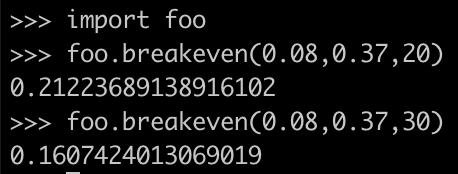
Let’s see what it gives:
Plot of breakeven point vs. N (# of years till retirement) with 
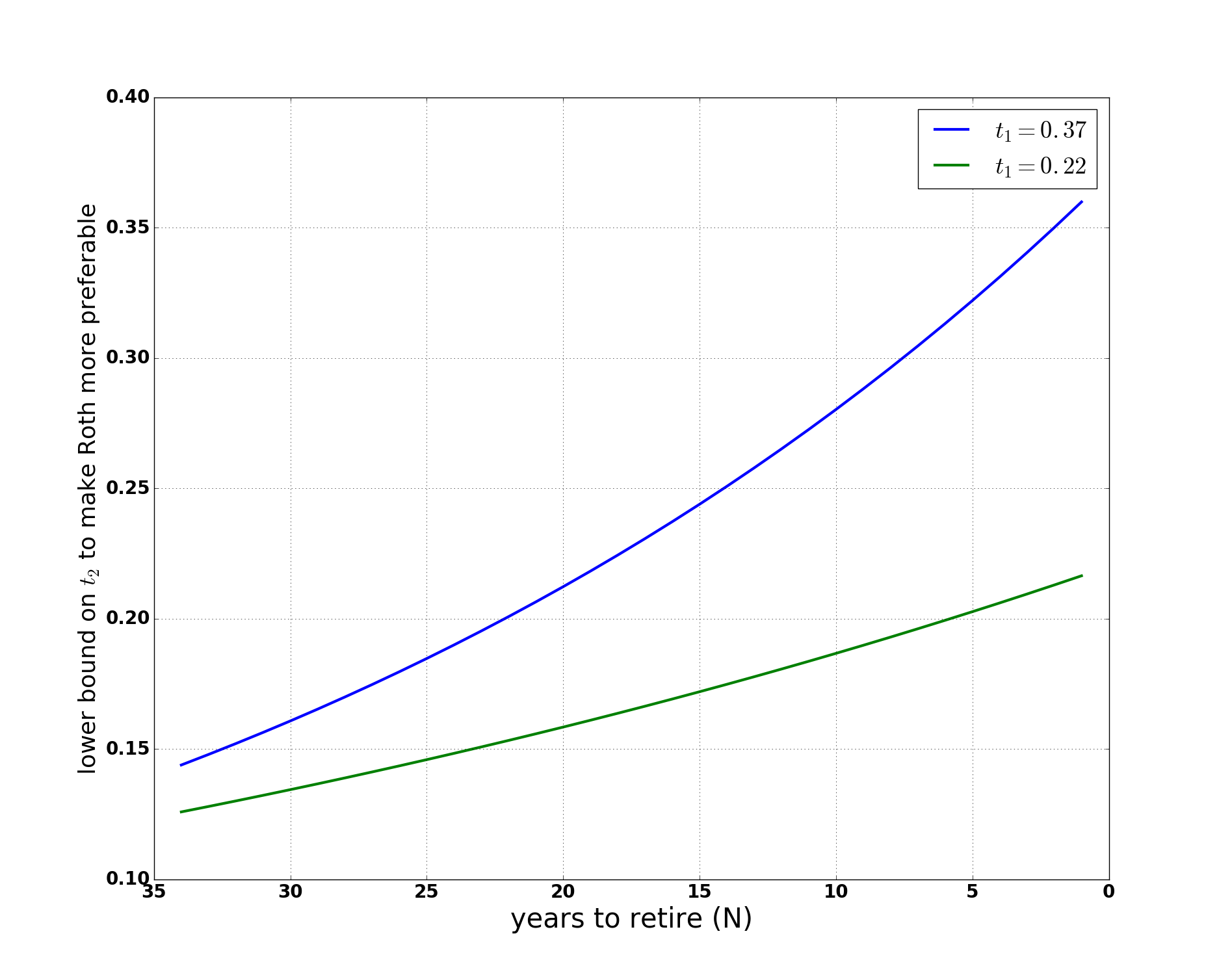
Enough math. Can I get it in English please? Investing in Roth makes sense if you are young (i.e., N ↑) or in a low tax bracket (
Conclusion: Go Roth when you are young and switch to Traditional 401k once you cross 40-45 years of age. For most people that represents mid-point of their career. Thus, in other words, the conclusion is to split evenly between Roth and Traditional 401k. Choose Roth for first-half of your career and Traditional for the second half.
of course, again all this is just bookish exercise for fun. Code is here.
 siddharth's space